
The First Weeks
After Loss
For the days when you don’t know what you’re supposed to feel, and for the love you are still carrying.
Download the printable PDF
A note from me
If you are holding this guide, something has happened that no one is ever ready for. You may be days into this, or weeks, or months. Wherever you are, I’m so incredibly sorry.
Families have taught me that there is no one way this is supposed to look. Some women cry constantly. Some don’t cry at all. Some feel overwhelmed or unlike themselves. These experiences can be part of grief. They do not mean you are weak or failing.
You may feel connected to your baby, unsure what you feel, or many things at once. In these pages I use “baby”; use “pregnancy” or any words that fit you. Whether your loss was early, later, or involved medical decisions, you belong here.
This guide won’t tell you how to feel, and it won’t rush you toward “getting over it.” There is no requirement to forget or leave your baby behind. Healing can include carrying that love while gradually making room for life again.
Read it slowly, in any order. Skip what doesn’t fit. Come back to it on the hard days.
Your baby mattered. Your love matters.
And you do not have to carry this alone.
~Yonina

You’re grieving more than one loss
Attachment doesn’t begin the day a baby is born.
For many of us, parenthood begins long before birth. A positive test. A first ultrasound. A felt kick. A chosen name. We start imagining, planning, loving, protecting. When a pregnancy ends in loss, you may be grieving a relationship that had already begun, a hoped-for future, or both.
You may be grieving more than one loss: your baby, and also the future you had already built in your mind: the first smile, grandparents meeting this child, siblings growing up together, a wedding someday. Those hopes mattered, even if you never had the chance to live them.
You may also miss the sense of trust you once had in your body or in what the future would hold. You do not need to have reached a particular milestone for your grief to matter.
That relationship may have been brief, but it was real.

Grief lives in your body too
Grief isn’t only emotional. Yes, there may be sadness, anger, guilt, fear, numbness. But grief can show up everywhere.
Feeling unlike yourself can be unsettling. Grief may affect your thoughts, feelings, body, and routines. You deserve support with any symptoms that worry you.
After pregnancy loss there is one more layer: your body may be recovering from pregnancy, birth, medication, or a procedure while you are grieving. Bleeding, breast changes, hormonal shifts, exhaustion. Every physical sensation can become another reminder of the baby who isn’t coming home. You aren’t only grieving. Your body is responding to the loss at the same time, and that combination can feel overwhelming. Be as gentle with your body as you would be with someone you love.

There’s no “right” way to grieve
Grief is not linear. It doesn’t move through predictable stages. It comes in waves.
You might feel relatively steady one moment and completely overwhelmed the next. That’s not inconsistency. That’s grief. A wave can come from a date, a reminder, or something as ordinary as walking past a pregnant woman or hearing a baby cry.
Tears aren’t the measure
How grief shows on the outside is called mourning: crying, silence, talking, ritual, or sometimes no visible reaction at all. People often judge grief by it, as if tears mean deep grief and no tears mean you aren’t grieving. That simply isn’t true.
We mourn differently because we are different. Culture matters, faith matters, personality matters, history matters. None of that tells anyone how much you loved your baby. There is no single outward sign that tells someone what you are carrying inside.
Tears do not measure your grief or your love.

Grief and trauma can overlap
After a loss, you may feel longing for your baby alongside fear, distressing memories, or a changed sense of safety. These experiences can overlap, but they are not identical.
Grief can involve the past, present, and future. Trauma responses can also involve memories of what happened and fear about what might happen next. These examples are ways to describe experiences, not a way to diagnose yourself.
You may be mourning your baby while also feeling distressed by how the loss happened or how you learned about it. Remembering that moment, or worrying about another pregnancy, does not by itself mean you have a trauma disorder.
Both your grief and your sense of safety deserve care. A therapist can help you understand what you are experiencing and what support may help.

If you feel numb, or can’t remember
During overwhelming experiences, some people have difficulty taking in information, remembering details, or feeling connected to what is happening.
You might remember a face or a sound very clearly but have little memory of the conversation. You may need information repeated. You may feel tearful, angry, on edge, unusually calm, or far away from yourself.
These reactions can happen after a loss. They are not a test of how much you cared or how well you are coping. Not everyone experiences them.
Some people stay busy researching or organizing; others need quiet or distance. These actions can have many meanings. You do not have to label every response to understand that this has been a lot to carry.
Small supports in the moment
- Ask your care team to write down important information.
- Invite someone you trust to help you remember questions.
- If it feels comfortable, notice your feet on the floor or a familiar object nearby.
- Give yourself permission to pause an overwhelming conversation.
If numbness, memory difficulties, or feeling outside your body are distressing, persistent, or interfering with daily life, reach out for professional support.
Silence does not always mean peace. Stillness does not always mean acceptance. You deserve care even when your grief is hard to see.

When your partner grieves differently
Maybe you’ve wondered why your partner seems quieter, or busier, or more “fine” than you. One of the most common misconceptions I hear is that the quieter partner is grieving less.
Many partners feel an enormous responsibility to stay strong. They answer questions, make phone calls, complete paperwork, tell family, and try to protect the person they love, while quietly carrying their own grief.
They’re often grieving in two directions at once: mourning the baby, and watching someone they deeply love suffer. Many feel they have to set their own grief aside to be “the strong one.” Their outward response may not tell you how they feel inside.
If you’re crying while your partner is focused on logistics, try not to mistake different expressions of grief for different depths of love. Sometimes it helps to turn to them and ask, “How are you doing?” and then make room for whatever answer comes, even if it’s “I don’t know.”
You do not need to guess what your partner feels or take responsibility for managing their grief. Both of you can ask for care, space, and support. Differences in grieving do not excuse hurtful or dismissive behavior.
Different expressions of grief do not tell us how deeply someone loves.

Telling your other children
If your children knew about the pregnancy, explain what happened simply and honestly, using words that fit their age. You might say: “The baby died. That means the baby’s body stopped working, and the baby cannot come home.” Adapt this to what happened in your family.
Reassure them: nothing they thought, said, or did caused the loss. Let them ask questions, now or later. It is okay to say, “I don’t know.” You may need to explain things more than once.
Children may move between sadness and play. This does not mean they do not care. Keep familiar routines where possible, and remind them who will care for them. They do not need to make your sadness go away.

Invisible grief
Pregnancy loss is often an invisible grief. Sometimes no one knew you were expecting, so no one knows you are grieving. And even when people did know, they may not know what to say, or may say nothing at all. Either way, the support you need may not arrive on its own.
There’s a name for this: disenfranchised grief. It simply means grief that isn’t fully recognized or supported by the people around you. People may not know what to do, or may underestimate the loss. They may rush toward reassurance instead of recognition. So you may hear:
“Everything happens for a reason.”
“You’re young. You’ll have another baby.”
Whatever someone’s intention, their words can still hurt. Acknowledgment often helps more than reassurance. If words like these left you feeling more alone, nothing is wrong with you. You needed to feel seen first.
Your grief doesn’t need to be solved. It needs to be witnessed. And it is real whether or not anyone else sees it.
Acknowledgment can help us feel less alone.

Staying connected to your baby
Healing does not have to mean leaving your baby behind. Some parents find comfort in a connection that changes over time.
For some parents, keeping a continuing bond with their baby is meaningful. A name is much more than a name. It’s identity. It’s relationship. It’s acknowledgment that your baby existed. Many parents tell me their greatest fear is that people will forget their baby. Hearing their baby’s name can feel comforting and affirming. Others prefer privacy or different words.
Gentle ways parents stay connected
- Saying your baby’s name, and inviting others to say it
- Lighting a candle
- Wearing jewelry with your baby’s initials
- Marking birthdays and anniversaries
- Keeping a small box of keepsakes
- Writing a letter to your baby
None of these mean you’re “stuck.” They are expressions of continuing love. And if you haven’t chosen a name, your baby is still yours to remember and to talk about.
These are options, not expectations. You do not have to name your baby, keep objects, or mark dates. Choose what fits your wishes and faith. For questions about mourning or remembrance practices in your tradition, ask a trusted rabbi, clergy member, or spiritual advisor.
You don’t have to let go to heal.

Thinking about trying again
Some parents want to try again soon. Some cannot imagine it yet. Some feel both at once. Your feelings may change from day to day.
There is no single emotional timeline. Ask your medical team when it is safe for you to try again, based on your recovery and the circumstances of your loss. Physical readiness and emotional readiness may not arrive together.
Some parents cannot try again or decide not to. That can bring its own grief, relief, uncertainty, or a mixture of feelings. You do not owe anyone a decision or an explanation.
Another pregnancy does not replace this baby. Whatever comes next, your loss still matters.

Small things that may help this week
Gentle invitations, with no need to complete them. Take what helps and leave the rest. You can skip the writing prompts, too.
- Let the waves come. You don’t have to be “doing better” by any certain day.
- Ask which decisions need attention now and which can wait.
- Ask again. It’s okay to ask your doctor or nurse to repeat information.
- Bring someone with you. To follow-up appointments, if you can. Another person there to hear what the doctor says and write it down means you do not have to hold it all yourself.
- Rest your body. It may still be healing.
- If it feels right, say your baby’s name or write a few words about your loss.
- Let one person sit with you, without needing to fix anything.
- Tell someone what you need. The next page can help.
A few words, just for you

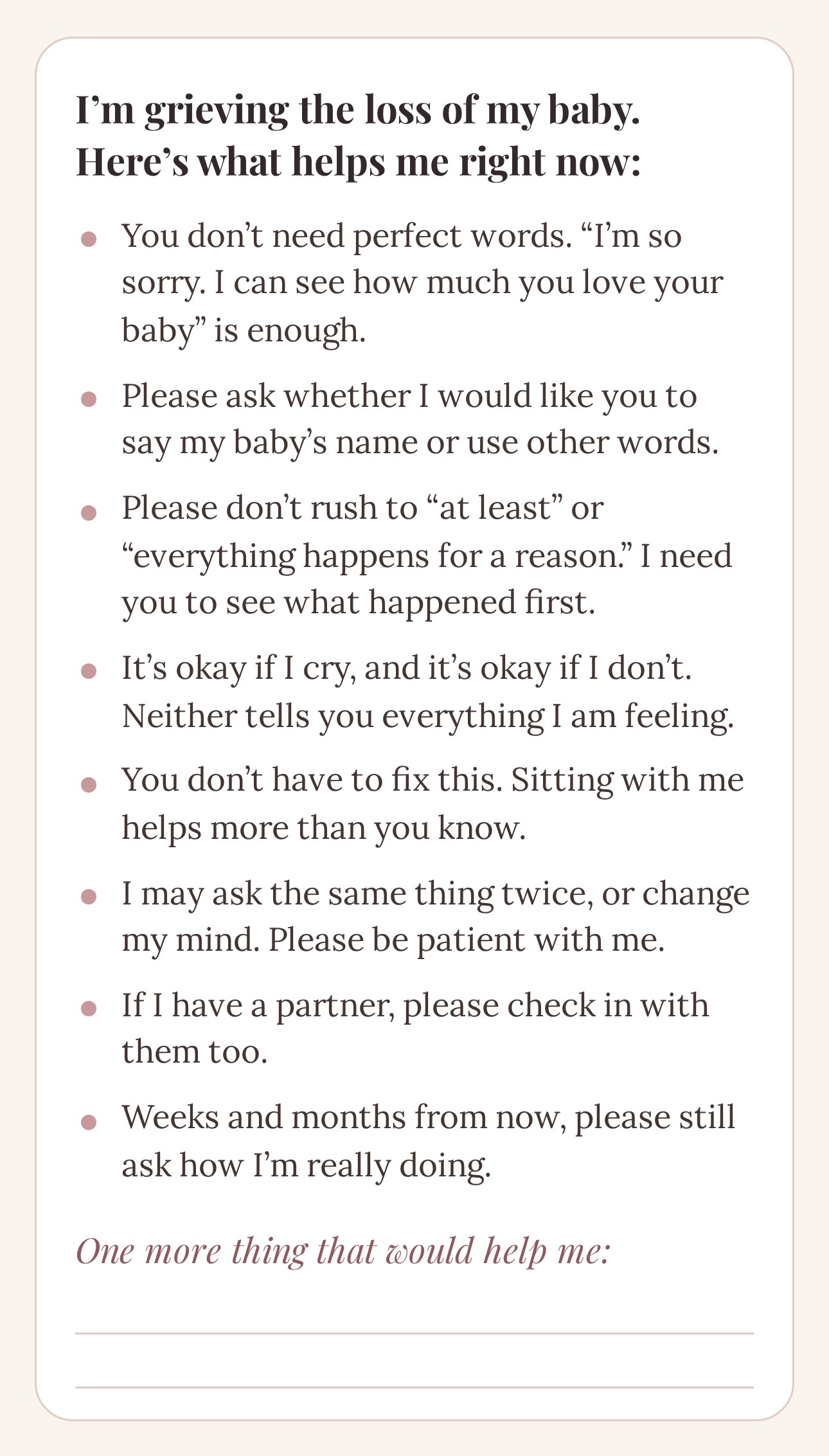
What I need from you
It can be hard to find the words, especially when the people around you don’t know what to say either. Choose the statements that fit you. You can share this page, send a photo of it, or read selected lines aloud.

When to reach out for more support
Grief itself is not a disorder, and intense grief does not automatically mean you have a mental health condition. You deserve support without having to prove that your grief is “serious enough.”
You do not need to wait until things feel unbearable, or meet criteria for a diagnosis, to ask for help. Support can be useful at any point.
It may help to talk with a therapist who understands pregnancy loss if:
- you can’t stop replaying what happened
- you’re avoiding hospitals, appointments, or anything that reminds you of the loss
- fear about another pregnancy feels like it’s taking over
- you often feel numb, foggy, or outside your body
- getting through everyday tasks keeps feeling harder
- you feel alone with your grief, and no one is asking
Grief can coexist with depression, anxiety, or trauma symptoms. Persistent hopelessness, panic, distressing unwanted thoughts, or difficulty caring for yourself deserve attention. If symptoms worry you, worsen, or disrupt daily life, contact your medical provider or a therapist. Effective treatments are available.
Reaching out is not weakness. It is one more way of caring for yourself, and for the love you carry.

About Yonina
Yonina Kaufman, LCSW-R, PMH-C, M.S.Ed. is a Licensed Clinical Social Worker specializing in Perinatal and Reproductive Mental Health, including infertility, pregnancy and infant loss, termination for medical reasons (TFMR), postpartum mood and anxiety disorders, and reproductive trauma. As the Clinical Coordinator of ATIME HUG, she supports women and couples experiencing perinatal and infant loss.
Yonina is also a social worker with the New York City Department of Education and an adjunct professor, teaching undergraduate and graduate courses in psychology and social work. She provides telehealth psychotherapy, clinical supervision, and parent training. Yonina presents nationally on compassionate bereavement care, reproductive mental health, and women’s health. Her evidence-based, compassionate approach helps clients navigate grief, healing, and parenthood.

Support and resources for you
You can also connect with me at @yoninakaufman.
If there’s one thing I hope you carry from these pages, it’s this: you do not have to grieve in a particular way to deserve support. Your loss matters, and you do not have to carry it alone.
Tikvaseinu and Yad Rachel focus on perinatal mood and anxiety support. Ask each organization about services, eligibility, availability, and any fees. Community support contacts are not a substitute for emergency care.
Monthly, Tuesdays at 9:30 pm · 718-686-8912 ext. 425 · code 047087
NIMH: Perinatal Depression
NHS: Pregnancy Loss - What can I expect following my pregnancy loss?
Support contacts checked against organization websites, October 26, 2026.
ATIME HUG: atime.org (general HUG contact).
Follow your own care team’s guidance.
© 2026 Yonina Kaufman. For personal use only.